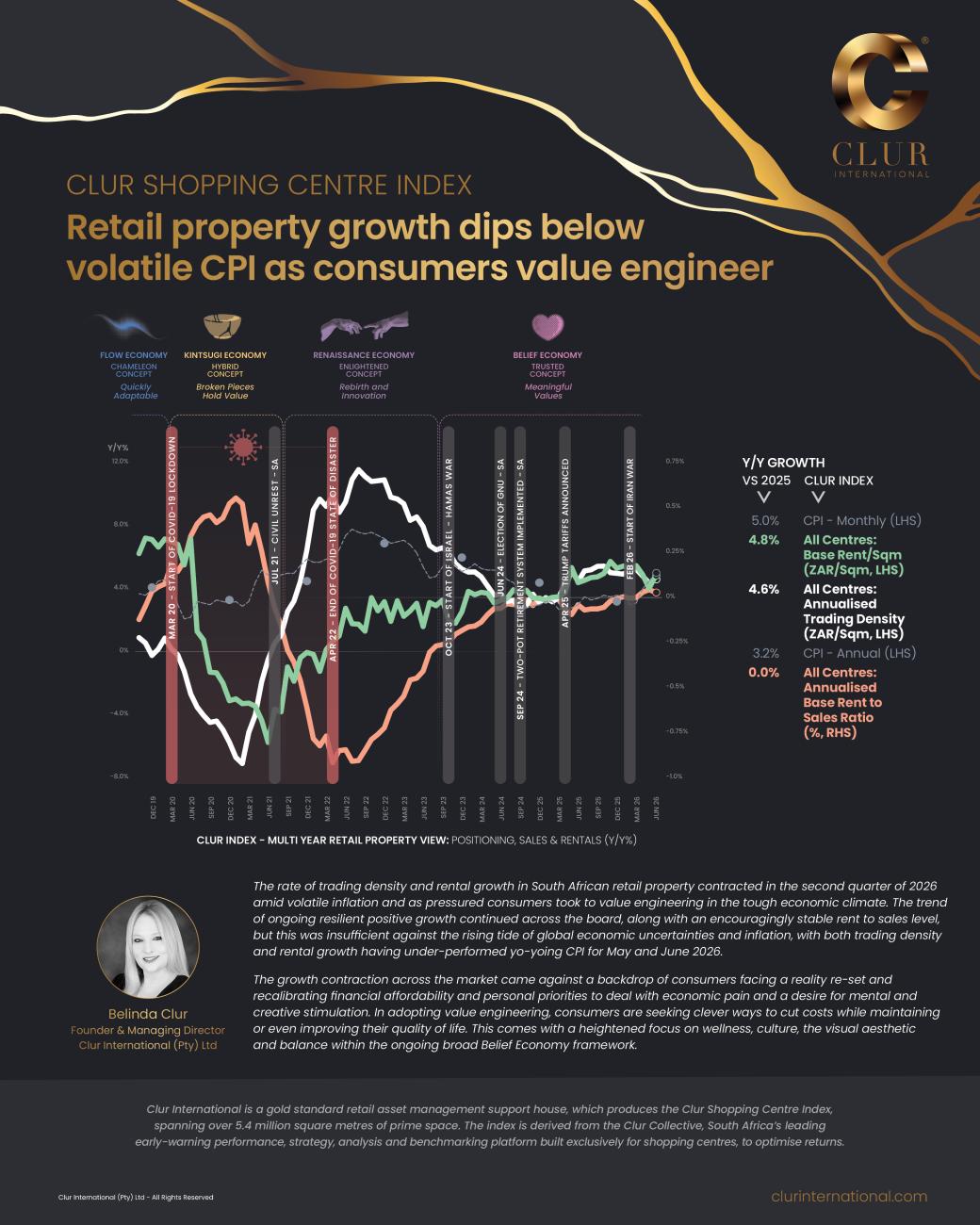
The rate of trading density and rental growth in South African retail property contracted in the second quarter of 2026 amid volatile inflation and as pressured consumers took to value engineering in the tough economic climate.
That’s according to the Clur Shopping Centre Index, which covers over 5.4 million square metres of space across listed and unlisted property funds in South Africa and Namibia. The index is derived from the Clur Collective, South Africa’s leading early-warning performance, strategy, analysis and benchmarking platform built exclusively for shopping centres, to optimise trading and returns.
“The trend of ongoing resilient positive growth continued across the board, along with an encouragingly stable rent to sales level, “said Belinda Clur, founder of the Clur Collective and managing director of Clur International. “But this was insufficient against the rising tide of global economic uncertainties and inflation, with both trading density and rental growth having under-performed yo-yoing CPI for May and June 2026.
“This marks an important inflection point, as the market trend had been reassuringly inflation-beating since October 2024. It seems the market is holding its breath about the outcome of November’s South African election, as well as a solution to ongoing global conflict, hoping that these will help drive a reversal of this trend,” Clur said.
“In adopting value engineering, consumers are seeking clever ways to cut costs while maintaining or even improving their quality of life.”
She said the Q2 2026 national Clur Index for All Centres closed at an annualised trading density of R43,612/sqm, and y/y% growth of 4.6%, under-performing June CPI by -0.4%. June’s CPI year to date high of 5% hamstrung the otherwise resilient growth of retail property.
“May 2026 marked the first time since September 2024 that trading density growth has under-performed CPI. This concerning inflationary trend underlines the impact of ongoing tumultuous times, exacerbated by the repercussions of the Iran war.”
Super-regional centres continued to hold the top y/y% growth spot at 5.1%, after overtaking community and smaller centres in February this year. Regional centres followed at 4.6%, having upped their game significantly since April 2025. Community and smaller centres came in at 4.4%, under-performing June CPI by -0.6% and contracting the most against December 2025, by -1.1%.
Super-regional centres were the only format to out-perform June CPI, by 0.1%, and to see a growth expansion against last December of 0.2%. All other formats under-performed CPI and saw growth contract against December.
Actual trading density volumes continued to be driven by the combination of very large and very small centres, a trend that has been firmly entrenched since June 2018. Top performance came from super-regionals at R53,643 /sqm, with community and smaller centres in an ongoing highly competitive position at R49,523 /sqm.
Clur said that across the three key provinces trading density growth continued to be dominated by Gauteng at 5.0%, having taken the top spot from the Western Cape since March 2026. The Western Cape was at 4.5% and KwaZulu Natal at 4.1% y/y growth. All three provinces under-performed June CPI and only KwaZulu Natal had a growth expansion against last December of 0.5%.
Provincial trading density volumes saw continued Western Cape dominance, at R50,629 /sqm. KwaZulu Natal followed at R45,353 /sqm and Gauteng delivered R42,178 /sqm.
The Q2 national Clur Index for All Centres closed at an annualised base rent to sales level of 6.6%, holding steady since the market-balancing time of mid-2024. Super-regional centres showed the highest base rent to sales level of 7.2% and community and smaller centres the lowest at 4.7%. Provincially, Gauteng had the highest base rent to sales level of 6.8%, and the Western Cape the lowest at 6.2%.
Clur said the Q2 2026 national Clur Index for All Centres closed at a base rent/ sqm level of R248.69. This represented y/y% growth of 4.8%, under-performing June CPI by -0.2%.
Super-regional centres showed the highest base rental levels of R335.64/ sqm, with y/y% growth of 4.5%, under-performing June CPI by -0.5%. Regionals were at R242.07/ sqm, growing by 4.6% y/y and under-performing CPI by -0.4%. Community and smaller centres showed the highest y/y% growth level of 5.6%, off R202.37/ sqm, out-performing CPI by 0.6%. Small regional centres also out-performed CPI by 0.2%, with y/y% growth of 5.2% and a R197.77/ sqm rate.
Provincially, top base rent/ sqm growth and base rental levels came from the Western Cape, at 5.3%, off R274.07/sqm, being the only of the three key provinces to out-perform June CPI, by 0.3%. KwaZulu Natal had 3.8% y/y% growth off R257.83/sqm and Gauteng 4.8% off R247.83/sqm.
Clur said the growth contraction across the market came against a backdrop of consumers facing a reality re-set and recalibrating financial affordability and personal priorities to deal with economic pain and a desire for mental and creative stimulation.
“The financial affordability re-set sees a high level of strategic value engineering across the market, as consumers seek clever ways to cut costs whilst maintaining, or even improving, their quality of life. This does not only apply to managing core groceries, utilities and debt repayments, but also to apparel, home, travel, transport and experiential decisions.
“In this contracted but resilient market we have a clever consumer who does not want to give up on luxuries. A high level of lipstick-index behaviour and nostalgia-desire is in play as consumers seek the emotional lift associated with purchases of small luxuries and the rose-tinted comfort of days gone by.
“The personal priority re-set sees a heightened focus on wellness, culture, the visual aesthetic and balance.”
Clur said the wellness economy has evolved into a highly sophisticated consumer-driven value and status symbol, increasingly influencing key purchasing decisions along with a growing wellness tourism trend.
“Linked to this, a focus on balance and personal zen is further entrenching as emotional health, better sleep, weight management, digital detox and cortisol control take centre stage, along with concerns around brain and bed rotting caused by AI convenience, lack of mental resistance and digital addiction.
“There is a strong desire for mental and creative stimulation, with a new focus on culture and the art of living. This embraces a rich thirst for worldly and specific knowledge around thought-provoking travel destinations, cultural traditions, art, design, cuisine, language and philosophy. An elevated visual aesthetic threads through all of these aspects as consumers show hunger for a visual feast, further supporting social media stories and backdrops as we live through pictures.
“Cultural curiosity has become trendy as intelligence and worldly knowledge hold status.”
Clur said within the broad framework of the ongoing Belief Economy, the consumer still desires trust, meaningful values, raw honesty and ‘in real life’ community and emotional connection, as a counter-weight to economic hardship and personal strain.The rate of trading density and rental growth in South African retail property contracted in the second quarter of 2026 amid volatile inflation and as pressured consumers took to value engineering in the tough economic climate.
That’s according to the Clur Shopping Centre Index, which covers over 5.4 million square metres of space across listed and unlisted property funds in South Africa and Namibia. The index is derived from the Clur Collective, South Africa’s leading early-warning performance, strategy, analysis and benchmarking platform built exclusively for shopping centres, to optimise trading and returns.
“The trend of ongoing resilient positive growth continued across the board, along with an encouragingly stable rent to sales level, “said Belinda Clur, founder of the Clur Collective and managing director of Clur International. “But this was insufficient against the rising tide of global economic uncertainties and inflation, with both trading density and rental growth having under-performed yo-yoing CPI for May and June 2026.
“This marks an important inflection point, as the market trend had been reassuringly inflation-beating since October 2024. It seems the market is holding its breath about the outcome of November’s South African election, as well as a solution to ongoing global conflict, hoping that these will help drive a reversal of this trend,” Clur said.
“In adopting value engineering, consumers are seeking clever ways to cut costs while maintaining or even improving their quality of life.”
She said the Q2 2026 national Clur Index for All Centres closed at an annualised trading density of R43,612/sqm, and y/y% growth of 4.6%, under-performing June CPI by -0.4%. June’s CPI year to date high of 5% hamstrung the otherwise resilient growth of retail property.
“May 2026 marked the first time since September 2024 that trading density growth has under-performed CPI. This concerning inflationary trend underlines the impact of ongoing tumultuous times, exacerbated by the repercussions of the Iran war.”
Super-regional centres continued to hold the top y/y% growth spot at 5.1%, after overtaking community and smaller centres in February this year. Regional centres followed at 4.6%, having upped their game significantly since April 2025. Community and smaller centres came in at 4.4%, under-performing June CPI by -0.6% and contracting the most against December 2025, by -1.1%.
Super-regional centres were the only format to out-perform June CPI, by 0.1%, and to see a growth expansion against last December of 0.2%. All other formats under-performed CPI and saw growth contract against December.
Actual trading density volumes continued to be driven by the combination of very large and very small centres, a trend that has been firmly entrenched since June 2018. Top performance came from super-regionals at R53,643 /sqm, with community and smaller centres in an ongoing highly competitive position at R49,523 /sqm.
Clur said that across the three key provinces trading density growth continued to be dominated by Gauteng at 5.0%, having taken the top spot from the Western Cape since March 2026. The Western Cape was at 4.5% and KwaZulu Natal at 4.1% y/y growth. All three provinces under-performed June CPI and only KwaZulu Natal had a growth expansion against last December of 0.5%.
Provincial trading density volumes saw continued Western Cape dominance, at R50,629 /sqm. KwaZulu Natal followed at R45,353 /sqm and Gauteng delivered R42,178 /sqm.
The Q2 national Clur Index for All Centres closed at an annualised base rent to sales level of 6.6%, holding steady since the market-balancing time of mid-2024. Super-regional centres showed the highest base rent to sales level of 7.2% and community and smaller centres the lowest at 4.7%. Provincially, Gauteng had the highest base rent to sales level of 6.8%, and the Western Cape the lowest at 6.2%.
Clur said the Q2 2026 national Clur Index for All Centres closed at a base rent/ sqm level of R248.69. This represented y/y% growth of 4.8%, under-performing June CPI by -0.2%.
Super-regional centres showed the highest base rental levels of R335.64/ sqm, with y/y% growth of 4.5%, under-performing June CPI by -0.5%. Regionals were at R242.07/ sqm, growing by 4.6% y/y and under-performing CPI by -0.4%. Community and smaller centres showed the highest y/y% growth level of 5.6%, off R202.37/ sqm, out-performing CPI by 0.6%. Small regional centres also out-performed CPI by 0.2%, with y/y% growth of 5.2% and a R197.77/ sqm rate.
Provincially, top base rent/ sqm growth and base rental levels came from the Western Cape, at 5.3%, off R274.07/sqm, being the only of the three key provinces to out-perform June CPI, by 0.3%. KwaZulu Natal had 3.8% y/y% growth off R257.83/sqm and Gauteng 4.8% off R247.83/sqm.
Clur said the growth contraction across the market came against a backdrop of consumers facing a reality re-set and recalibrating financial affordability and personal priorities to deal with economic pain and a desire for mental and creative stimulation.
“The financial affordability re-set sees a high level of strategic value engineering across the market, as consumers seek clever ways to cut costs whilst maintaining, or even improving, their quality of life. This does not only apply to managing core groceries, utilities and debt repayments, but also to apparel, home, travel, transport and experiential decisions.
“In this contracted but resilient market we have a clever consumer who does not want to give up on luxuries. A high level of lipstick-index behaviour and nostalgia-desire is in play as consumers seek the emotional lift associated with purchases of small luxuries and the rose-tinted comfort of days gone by.
“The personal priority re-set sees a heightened focus on wellness, culture, the visual aesthetic and balance.”
Clur said the wellness economy has evolved into a highly sophisticated consumer-driven value and status symbol, increasingly influencing key purchasing decisions along with a growing wellness tourism trend.
“Linked to this, a focus on balance and personal zen is further entrenching as emotional health, better sleep, weight management, digital detox and cortisol control take centre stage, along with concerns around brain and bed rotting caused by AI convenience, lack of mental resistance and digital addiction.
“There is a strong desire for mental and creative stimulation, with a new focus on culture and the art of living. This embraces a rich thirst for worldly and specific knowledge around thought-provoking travel destinations, cultural traditions, art, design, cuisine, language and philosophy. An elevated visual aesthetic threads through all of these aspects as consumers show hunger for a visual feast, further supporting social media stories and backdrops as we live through pictures.
“Cultural curiosity has become trendy as intelligence and worldly knowledge hold status.”
Clur said within the broad framework of the ongoing Belief Economy, the consumer still desires trust, meaningful values, raw honesty and ‘in real life’ community and emotional connection, as a counter-weight to economic hardship and personal strain.